

Introduction
In a case concerning a house in Oleshky, Kherson Region, destroyed after the Kakhovka Hydroelectric Power Plant was blown up, Disputes Law Firm had to resolve three questions: how to prove that the property existed and what it was worth when there is no access to it; against whom to bring a claim for damages when the harm was caused by a foreign state; and how to obtain a judgment when the defendant cannot be served with documents.
The house was jointly owned by a Ukrainian citizen and a British citizen. On their behalf, Disputes Law Firm prepared and filed a claim against the russian federation, the aggressor state, for compensation for property damage and non-pecuniary (moral) damage.
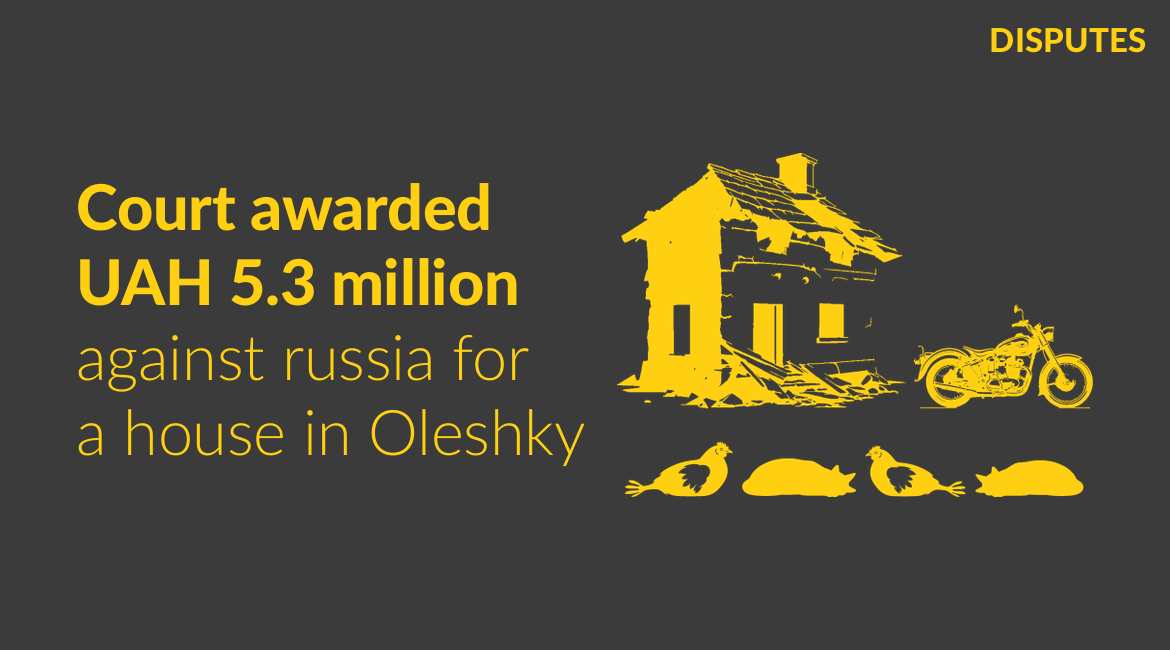
By a default judgment of August 5, 2026 in case No. 357/20861/25, the Volodarka District Court of Kyiv Region granted the claim in full. The court awarded the two co-owners a total of UAH 5.3 million against the russian federation: property damage, non-pecuniary damage, the cost of the property appraisal, and legal fees.
The Client's Problem
Before the full-scale invasion, the co-owners lived in their house in Oleshky, Kherson Region. They bought the house in March 2020, renovated it, set up their household, kept a small farm, and had pets. Oleshky lies on the left bank of the Dnipro, opposite Kherson, and from February 2022 the town was under the control of the occupying forces.
The owners lived under occupation in their own house for almost a year. They then left with the help of volunteers for the Autonomous Republic of Crimea, from there for Estonia, and later for Ireland. After leaving, they lost access to the house.
On June 6, 2023, the occupying forces blew up the Kakhovka Hydroelectric Power Plant. After the dam was breached, water flooded a number of towns and villages downstream on the Dnipro, including Oleshky. In a single day the owners lost their house, everything in it, and their farm.
After the flood, the Ukrainian co-owner lost contact with her mother, who had stayed in the house to look after the animals, so she returned to Oleshky. For three days she cleared the debris, searched for surviving documents and belongings, and photographed the destroyed property. While she was in territory controlled by the occupying forces, her life was in real danger.
Legal Position and Steps Taken
A claim for damages against the aggressor state
The owners turned to Disputes Law Firm for legal assistance. The remedy chosen was a claim against the russian federation, the aggressor state, for compensation for property damage and non-pecuniary damage, that is, a claim against the party that caused the harm.
Damage caused to the property of an individual must be compensated in full by the person who caused it (Article 1166(1) of the Civil Code of Ukraine). The house was destroyed by water after the occupying forces blew up the dam, so the aggressor state is obliged to compensate its value. In addition to property damage, the plaintiffs claimed compensation for non-pecuniary damage under Article 23 of the Civil Code of Ukraine.
A criminal complaint to the police before filing the claim
Before the claim was filed, the attorney submitted a criminal complaint to the police. The complaint concerns criminal offenses under Articles 438 and 441 of the Criminal Code of Ukraine (war crimes and ecocide).
The complaint was filed so that the pre-trial investigation authority would enter the information in the Unified Register of Pre-Trial Investigations, open an investigation, recognize the owners as victims, and record in the criminal case file the destruction of their property caused by the blowing up of the dam. The photo tables of the property before and after the flood and other materials collected for the complaint were later submitted by the plaintiffs as evidence in the civil case for damages.
Appraisal of the destroyed property
In a case of this kind, the plaintiff must prove the amount of property damage with a property appraisal report. Most appraisers refused to appraise property left in the temporarily occupied territory because they could not inspect it on site and did not have the usual source data.
The appraiser determined the market value of the house with its outbuildings and structures as of February 23, 2022, the last day before the full-scale invasion, on which the property was still undamaged. Applying the sales comparison approach, the appraiser calculated the value from the title documents, the technical characteristics of the property, and data on the value of comparable properties. The market value of the owners' vehicles and other movable property was appraised separately, as of September 8, 2025. The court admitted the appraisal reports, submitted by the plaintiffs' representative, to the case file and accepted them as evidence of the amount of property damage.
Sovereign immunity of the aggressor state
As a general rule, a claim may be brought against a foreign state, and that state may be joined as a defendant, only with the consent of its competent authorities (Article 79(1) of the Law of Ukraine "On Private International Law").
This rule does not apply, however, to disputes over compensation for damage caused by armed aggression. The Supreme Court proceeds from the premise that an act of armed aggression committed by a state is not an exercise of its sovereign rights but a breach of its obligation to respect the sovereignty and territorial integrity of another state. The aggressor state therefore may not rely on sovereign immunity to avoid liability for the damage it has caused (Supreme Court rulings of May 18, 2022 in case No. 760/17232/20-ц and of April 14, 2022 in case No. 308/9708/19). On that basis, Ukrainian courts hear such claims without the consent of the russian federation.
Venue and exemption from the court fee
The claim was filed with the court at the plaintiffs' place of residence in Ukraine. Claims to protect the rights of individuals violated in connection with the armed aggression of the russian federation and the temporary occupation of the territory of Ukraine, including claims for compensation for damage caused by the destruction of real property, may also be brought at the plaintiff's place of residence or stay (Article 28(17) of the Civil Procedure Code of Ukraine).
The plaintiffs did not pay a court fee, because in cases against the russian federation, the aggressor state, for compensation for property and non-pecuniary damage, plaintiffs are exempt from the fee in all court instances (Article 5(1)(22) of the Law of Ukraine "On Court Fees").
Notifying the defendant without diplomatic channels
The court could not notify the defendant of the proceedings in the usual way. On February 24, 2022, Ukraine severed diplomatic relations with the russian federation, and postal exchange between the two states stopped. For this reason the plaintiffs could not send the defendant a copy of the statement of claim with its attachments, and, under the Supreme Court's position cited above, a request for the aggressor state's consent to the proceedings cannot be sent. The court notified the defendant of the proceedings by court correspondence and by a notice on the official website of the judiciary, and found this notification proper.
Result
The court granted the claim in full. By the default judgment of August 5, 2026 in case No. 357/20861/25, each co-owner was awarded property damage in the amount of the value of the destroyed property, non-pecuniary damage, and court costs.
| Award | Ukrainian citizen | British citizen |
|---|---|---|
| Property damage | UAH 434,524 | UAH 858,293 |
| Non-pecuniary damage | UAH 2,000,000 | UAH 2,000,000 |
| Property appraisal costs | UAH 19,700 | — |
| Legal fees | — | UAH 45,000 |
The court fee of UAH 15,590.20, which the plaintiffs were exempt from paying, was recovered from the russian federation for the benefit of the state. In total, the court awarded the two plaintiffs UAH 5,357,517.
The court issued the judgment by default. A court may issue a default judgment on the basis of the evidence in the case file if the defendant, duly notified of the hearing, fails to appear and does not file a statement of defense, and the plaintiff does not object to the case being decided this way (Article 280(1) of the Civil Procedure Code of Ukraine). Because the russian federation did not take part in the proceedings and did not file a statement of defense, the court decided the dispute on the evidence in the case file. The defendant could have applied for review of the default judgment within thirty days of its pronouncement and did not do so, so the judgment became final on September 4, 2026.
Conclusion
The court thus found that the destruction of the plaintiffs' house and other property as a result of the blowing up of the Kakhovka Hydroelectric Power Plant is damage caused by the armed aggression of the russian federation. Both co-owners, the Ukrainian citizen and the British citizen, are entitled to compensation, because compensation for damage caused by the temporary occupation to citizens of Ukraine, foreigners, and stateless persons is the responsibility of the russian federation (Article 5 of the Law of Ukraine "On Ensuring the Rights and Freedoms of Citizens and the Legal Regime in the Temporarily Occupied Territory of Ukraine").
For the plaintiffs, this judgment is an indisputable record of the damage they suffered, including non-pecuniary damage. The court established the destruction of the property, its value, and the amount of non-pecuniary damage while the evidence could still be collected and examined. Circumstances established by a final court judgment do not have to be proved again in another case involving the same parties (Article 82(4) of the Civil Procedure Code of Ukraine), so the plaintiffs can rely on this judgment in the future.
As of November 2026, the state has not introduced a mechanism for the compulsory enforcement of court judgments awarding money against the aggressor state. At the same time, a court judgment is binding, and the state ensures its enforcement in the manner prescribed by law (Article 129-1 of the Constitution of Ukraine). There is therefore reason to expect that such a procedure will be established, and the plaintiffs will then be able to submit the judgment for enforcement.
Disputes Law Firm provides legal assistance to individuals in cases for compensation for property and non-pecuniary damage caused by the armed aggression of the russian federation: we collect and preserve evidence, prepare the criminal complaint, arrange the appraisal of the destroyed property, draft the claim against the aggressor state, and represent the plaintiff in court.


